
Paradox of Choice
Too many options can freeze a programme
The Paradox of Choice shows up when optionality becomes paralysis. In mega programmes, dozens of design routes, governance paths, and commercial scenarios feel like flexibility but act like friction. Decisions slow, accountability blurs, and momentum leaks away.
An Integrator doesn’t remove choice. They create discipline around it.
They narrow the field to a few meaningful routes, expose the tradeoffs, and make the remaining options comparable and actionable.
Decision quality isn’t improved by considering everything.
It improves when the right options stay visible, comparable, and forward‑moving.
If your board is drowning in options, we can show a 48‑hour decision sprint that clears the fog.
Hedonist Paradox

The Hedonist Paradox in Mega‑Programmes
The Hedonist Paradox appears when success metrics become the goal instead of meaningful outcomes. In mega‑programmes, targets, dashboards, and performance indicators can create the appearance of progress while pulling attention away from what the programme was actually designed to achieve.
An integrator doesn’t remove metrics and they re‑anchor teams to purpose.
They challenge performance theatre, reconnect measures to real outcomes, and keep decisions focused on the value the programme is intended to deliver.
Programme success doesn’t improve by hitting every number. It improves when performance stays connected to purpose, outcomes, and real value.
If your programme is hitting the metrics but losing the mission, we can help bring purpose back into focus.
Acceptance Paradox
The Acceptance Paradox in Mega-Programmes
In mega-complex environments, acceptance is not surrender. It is the foundation of intelligent change. The Acceptance Paradox appears when organisations seek transformation without fully acknowledging their current reality. In mega-programmes, perceived maturity can conceal capability gaps, distort priorities, and create plans that are more ambitious than the system is prepared to deliver.
Integrators make it safe to surface uncomfortable truths, challenge assumptions, and examine current capability without blame or defensiveness. Only then can improvement efforts be directed where they will create the greatest value: the ability to separate aspiration from reality, without diminishing either.
Because sustainable transformation does not begin with where an organisation hopes to be. It begins with understanding where it actually is. Only when reality is acknowledged can capability be strengthened, risks be addressed, and meaningful progress be achieved.
Region-beta Paradox
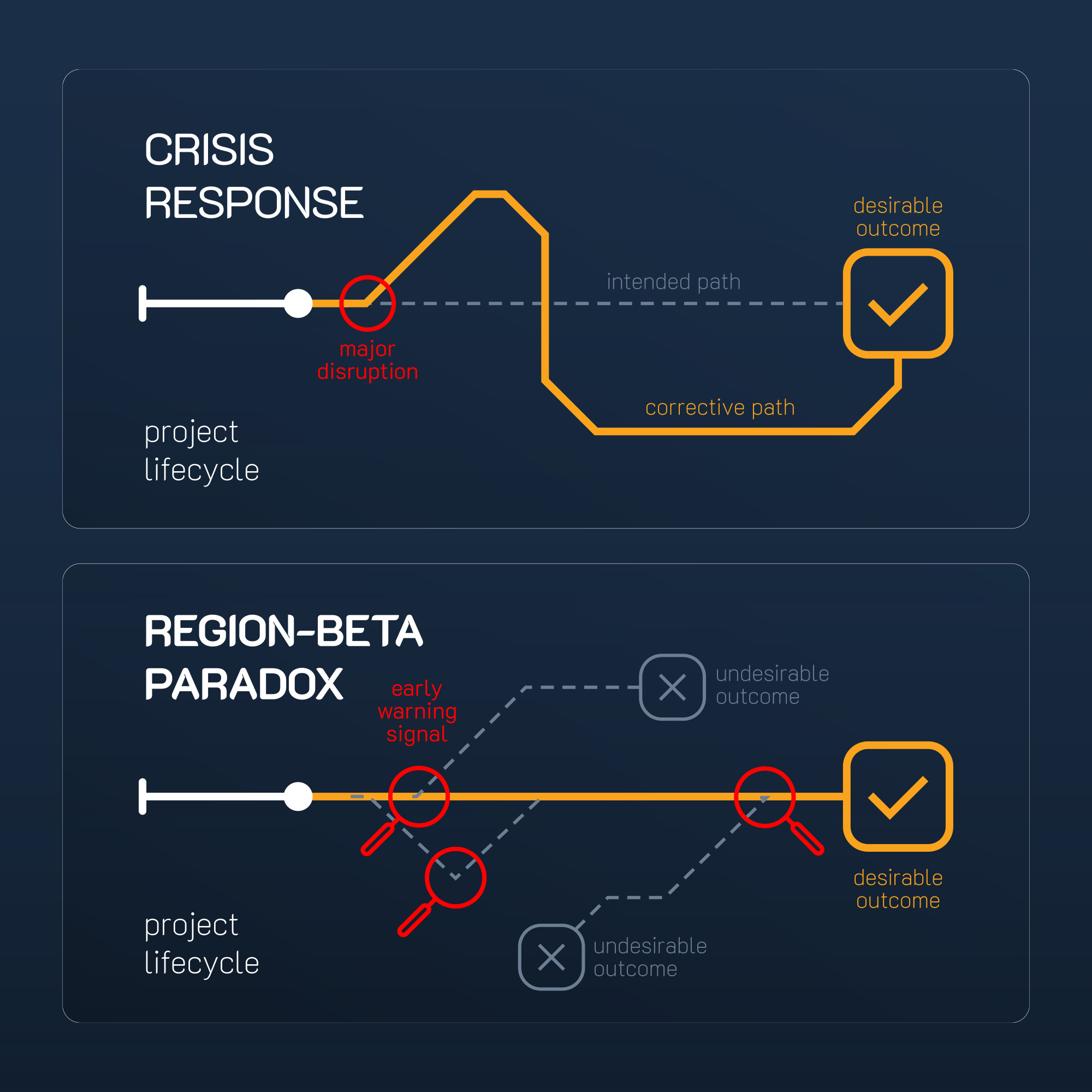
Sometimes a major crisis is resolved faster than a persistent, manageable problem.
The Region‑Beta Paradox appears when severe disruption triggers decisive action, while lower‑level dysfunction remains tolerated because it never feels urgent enough to address. The capability here is the ability to detect and respond to emerging fragmentation before the system is forced to react. In mega‑programmes, these issues rarely announce themselves as emergencies. They emerge as recurring friction between teams, unresolved dependencies, governance workarounds, duplicated effort, inconsistent information, or decisions that are repeatedly deferred.
Over time, these seemingly minor compromises become embedded within the delivery system, quietly accumulating risk and eroding coherence. An Integrator does not wait for dysfunction to become a crisis.
They recognise weak signals, behavioural drift, and recurring patterns of misalignment as indicators of deeper structural problems. They understand that today’s inconvenience often becomes tomorrow’s programme failure.
This is another dimension of The Integrator’s Edge®: the ability to see fragmentation while it is still being mistaken for normality. Because not every serious risk arrives as an emergency. Some develop slowly because the organisation has learned to live with them. The earlier those patterns become visible, the more options a programme has to restore alignment, strengthen coherence, and protect value. In mega‑complex environments, the greatest threats are often not the crises everyone can see.
They are the compromises nobody questions anymore.
The Ironic Process Theory in Mega-Programmes
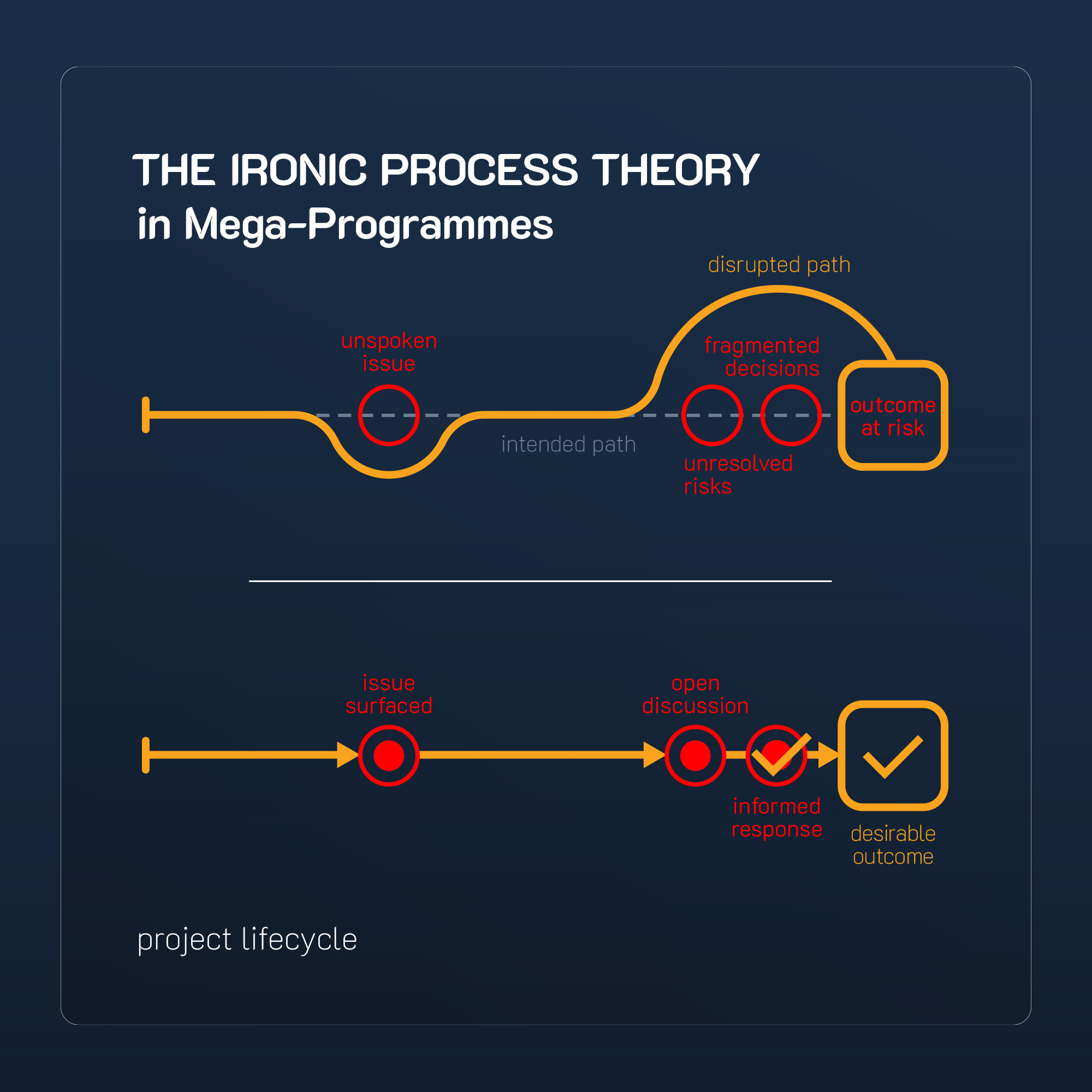
The harder an organisation tries not to talk about a problem, the more influence that problem begins to exert. Ironic Process Theory describes how attempts to suppress certain thoughts or concerns can make them more persistent. In mega‑programmes, the same dynamic emerges when political, commercial, or reputational pressure makes difficult issues unsafe to surface. Problems disappear from the conversation. They do not disappear from the programme. Instead, they reappear as governance workarounds, unresolved risks, behavioural drift, inconsistent narratives, duplicated effort, and fragmented decision‑making. Left unchallenged, these hidden issues quietly accumulate until they begin influencing outcomes across the entire delivery ecosystem.
An Integrator creates the conditions for difficult information to move in the opposite direction. They surface weak signals, reduce the pressure around uncomfortable conversations, and restore visibility where silence has created uncertainty. Their role is not to create conflict, but to make reality discussable before it becomes embedded in delivery.
This is another dimension of The Integrator’s Edge®: the ability to restore visibility where silence is creating risk. Because silence does not reduce complexity. It simply removes the opportunity to respond to it. When difficult truths become visible, programmes regain the ability to make informed decisions, restore alignment, and protect value.
In mega‑complex environments, what remains unspoken often becomes more dangerous than what is openly discussed.
The Solitude Paradox in Mega-Programmes
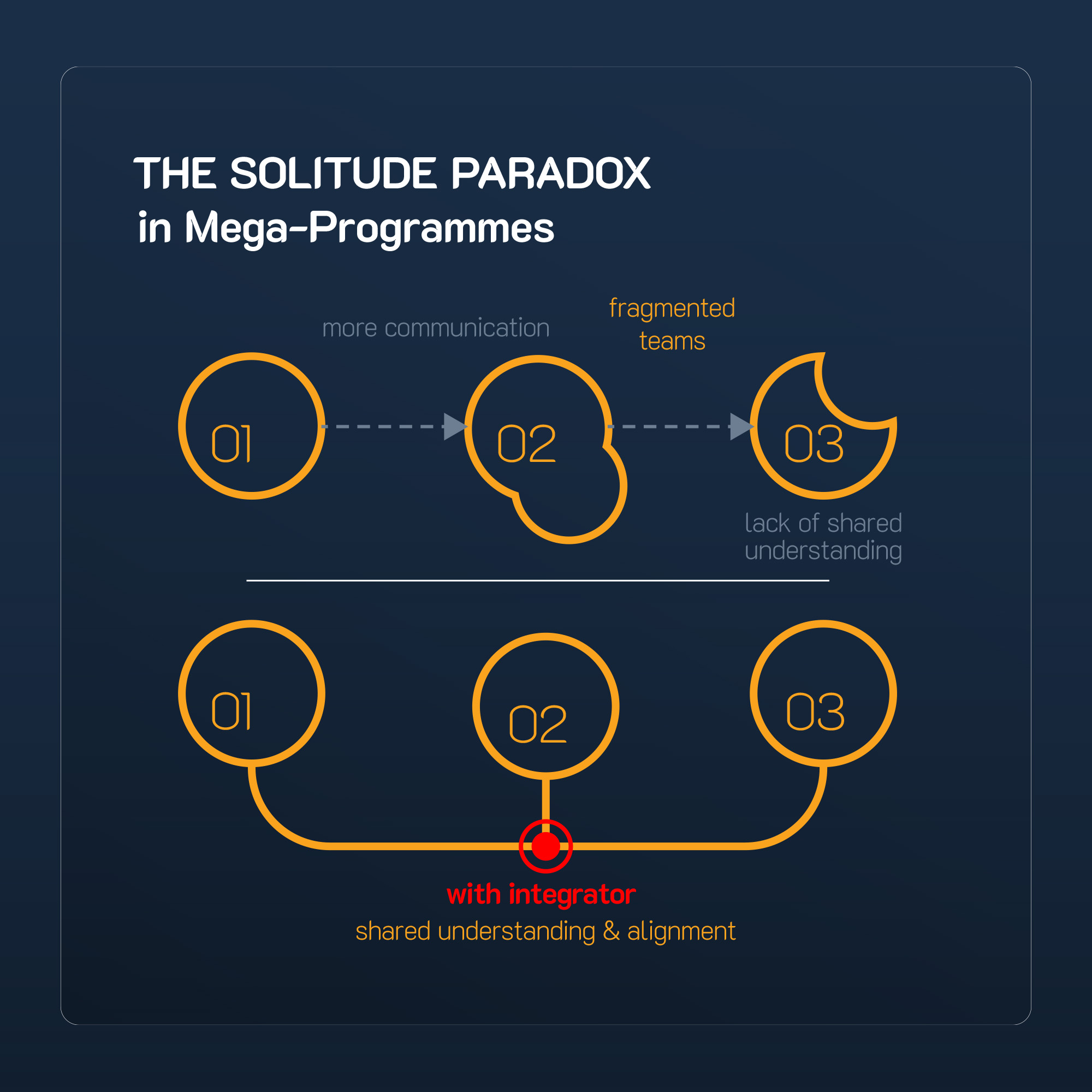
A programme can be constantly connected and still be deeply fragmented.
Mega‑programmes bring together hundreds of people, organisations, suppliers, functions, and sometimes sovereign actors. Meetings multiply. Communication channels expand. Information moves constantly. Yet delivery teams can still operate in isolation, separated by contractual boundaries, competing incentives, fragmented governance, and different organisational realities.
This is the Solitude Paradox: more connection does not automatically create greater connectedness.
An Integrator works across those boundaries. They build trust where relationships are weak, create understanding where perspectives diverge, and reconnect fragmented parts of the delivery ecosystem. They recognise that alignment depends not only on information flowing, but on people sharing a common understanding of what that information means. This is another dimension of The Integrator’s Edge®: the ability to transform communication into coherence.
Because coordination is not achieved by putting more people into the same meeting. It is achieved when people understand each other well enough to act together. In mega‑complex environments, fragmentation rarely occurs because people stop talking.
It occurs because they stop understanding.

Contact Details
For a confidential, multi-discipline project health check,
please contact us:
Email: info@nuphoenix.co.uk
Registered and correspondence address:
NuPhoenix Limited, 47 Butt Road, Colchester CO3 3BZ England, UK
Telephone number: +44 1206 564 379