
Integrator Value #1: Strategic Alignment
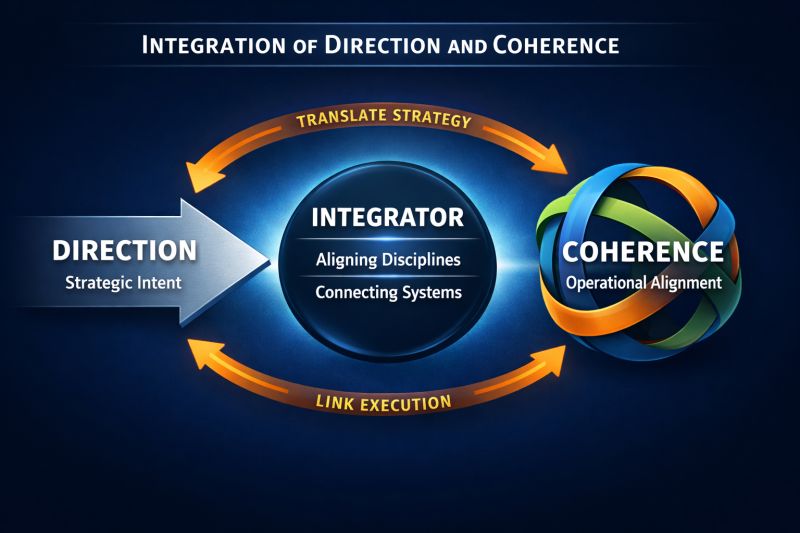
Projects don’t fail because people don’t work hard. They fail because people work hard on the wrong things. That’s why Integrators exist.
They don’t chase deliverables. They chase direction. They don’t ask, “Is this done?” They ask, “Does this move the system?”
An Integrator aligns decisions, disciplines, and dependencies so the organisation moves as one and not as a collection of disconnected efforts. Because success is not measured by output but must be measured by coherence otherwise we risk misalignment of decisions and cause stakeholder fragmentation.
Integrator Value #2: Decision Leadership
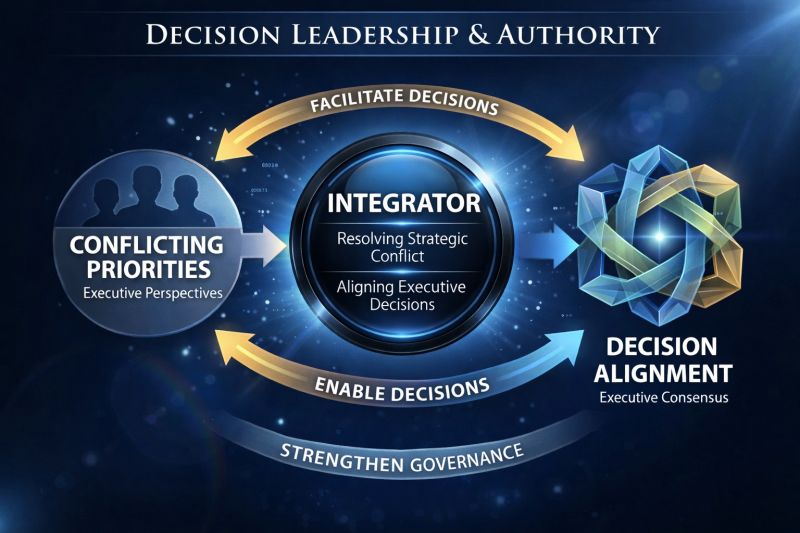
Projects do not stall because decisions are hard. They stall because executives do not decide together.
That is where an Integrator creates value. Not by replacing authority, but by activating it. An Integrator brings competing priorities into one decision space, resolves strategic conflicts before they cascade optionality, and ensures that executive direction becomes organisational momentum. Not presenting a fully baked cake missing some vital ingredieces.
They do not decide what the business should do. They ensure the business is able to decide via well designed and executed governance. They push for discipline. Because when leadership misalignment persists, uncertainty spreads, progress is stalled. The trust is lost across the whole organisation.
Integrator Value #3: Operational Street Smarts
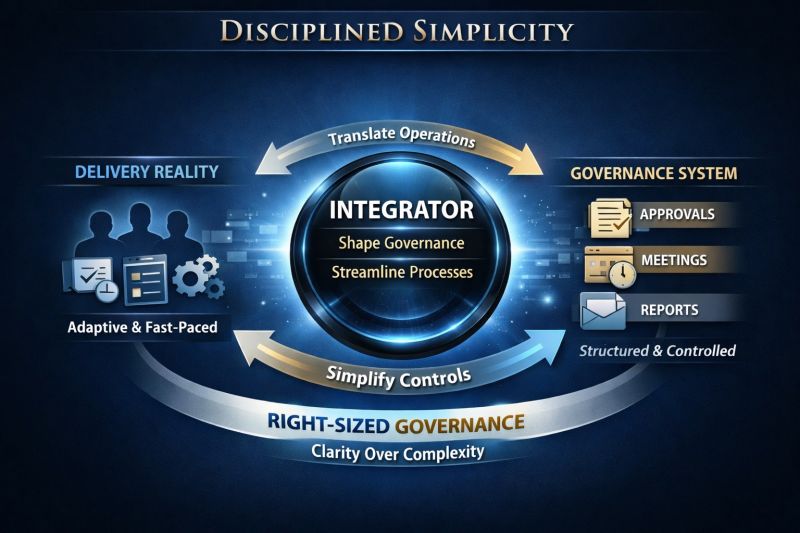
Projects do not slow down because people lack capability, but they slow down because processes become heavier than the work itself.
That’s where an Integrator creates value. Not by adding governance, but by designing governance that fits the reality of delivery. An Integrator has lived in the trenches and he/she knows where discipline creates clarity and where bureaucracy creates friction.
They right‑size processes: simple enough for teams to adopt, structured enough for leaders to trust.
Every unnecessary approval, meeting, or document consumes time that should be creating value and good governance is not measured by the number of controls. It is measured by how effectively it enables execution. The operational excellence cannot be about more process because it is about coherence between discipline and delivery.
Integrator Value #4: Process Architecture & Pitfall Detection
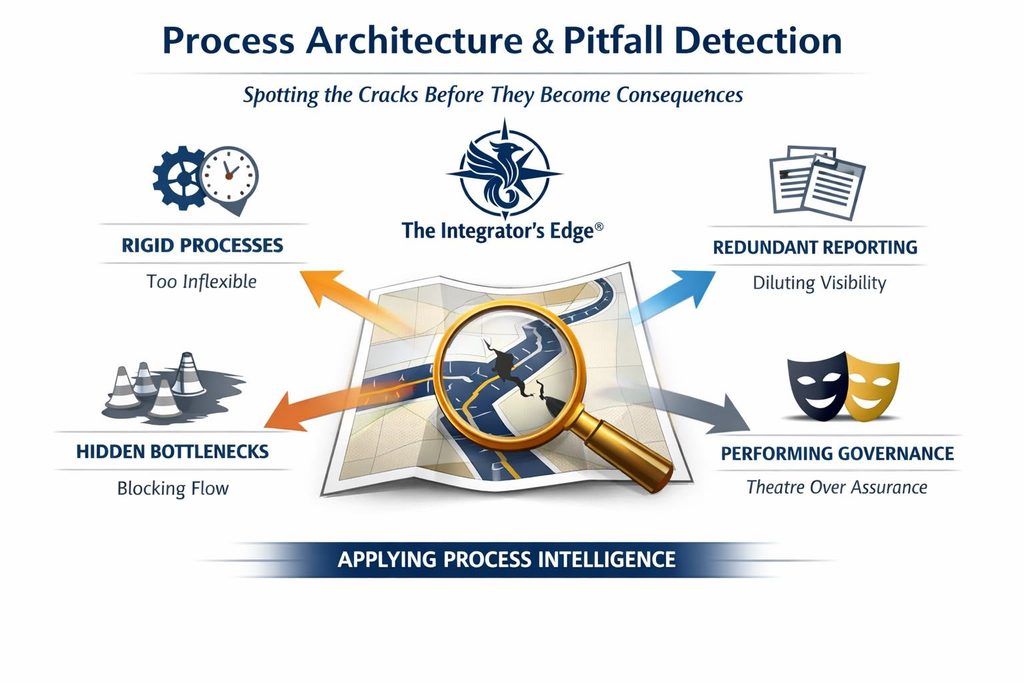
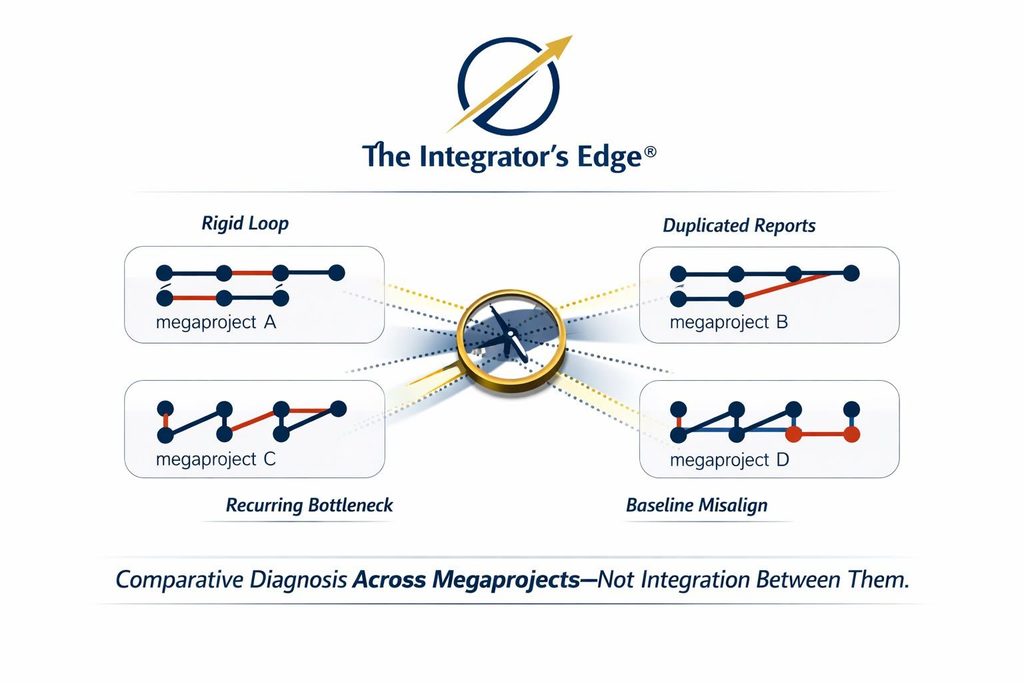
Process architecture in megaprojects is never a copy‑and‑paste exercise. Each programme carries its own fragmentation, its own behavioural dynamics, and its own hidden failure pathways. That’s why integrators do not apply process templates. They apply process intelligence.
An Integrator creates value not by imposing a one‑size‑fits‑all execution model, but by diagnosing where the model will break before the programme does.
Because integrators operate across commercial, technical, and assurance interfaces, they see patterns others miss. They compare the execution structure in front of them with the failure dynamics observed across other megaprojects; duplicated reporting, rigid governance loops, misaligned baselines, and the subtle bottlenecks that quietly erode momentum.
This is the essence of The Integrator’s Edge®:
the capability to read a delivery system like a map and this spot the cracks before they become consequences. With strong process savviness, an integrator can identify:
• where a process is too rigid for the pace of delivery
• where reporting is redundant and diluting visibility
• where hidden bottlenecks are slowing decision pathways
• where governance is performing theatre instead of assurance
Process architecture is not about designing structure. It’s about detecting failure early enough to prevent it. And in complex supply chains, that is where integrators protect real value.
Integrator Value #5: Human Capital Assessment & Calibration
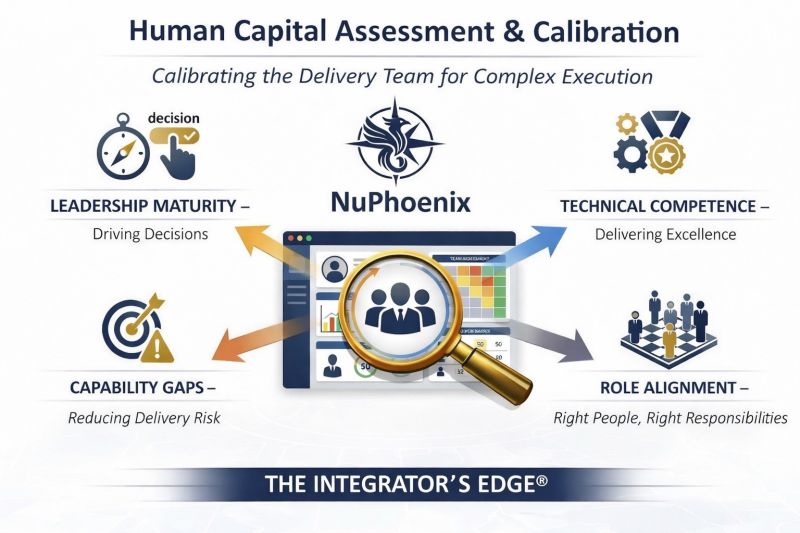
Megaprojects do not normally struggle because people lack talent but they struggle because talent is deployed in the wrong context.
That is where an Integrator creates value, not by replacing people, but by calibrating capability.
Operating across commercial, technical, and assurance interfaces, an integrator assesses whether the client’s team has the leadership maturity, technical competence, and decision‑making capability required for the complexity of the programme. They identify where strengths can be leveraged, where capability gaps create delivery risk, and where additional support is needed before optimisation begins.
This is the human‑capital dimension of The Integrator’s Edge®: the ability to read a delivery system through its people and thus understand whether capability, responsibility, and organisational ambition are aligned.
Because successful transformation depends on more than processes because dependence is on the people responsible for executing them.
Human capital assessment is not about evaluating individuals because it is about ensuring that capability architecture matches the complexity architecture of the programme. In fragmented environments, that alignment is what enables sustainable execution and protects long‑term value.
Integrator Value #6: Technical & Structural Deep Dive
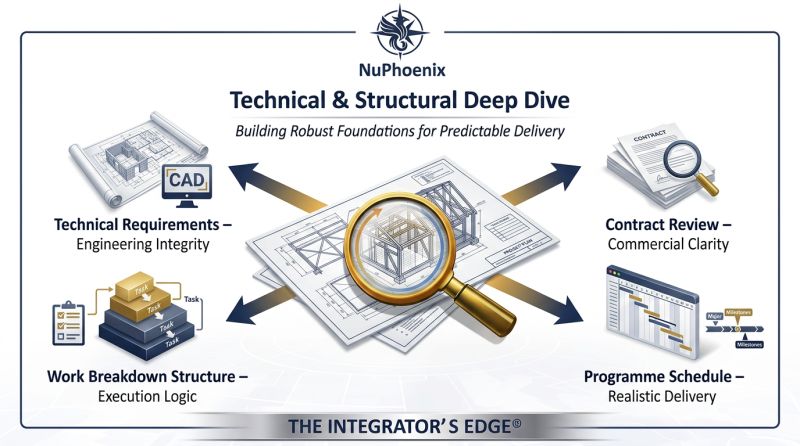
Projects rarely fail because the vision is wrong, but they fail because the structure beneath that vision cannot support the execution.
That is why Integrators do not begin with assumptions, and we begin by dissecting the framework that holds the programme together.
A Technical & Structural Deep Dive examines the engineering logic, contractual obligations, Work Breakdown Structure (WBS), and delivery schedule as one interconnected system. Every dependency is tested, every milestone challenged, and every interface reviewed with the goal to determine whether the programme is genuinely deliverable, not merely well documented.
This is another dimension of The Integrator’s Edge®: the capability to expose structural weaknesses before they become operational failures, ensuring that plans are resilient under real project conditions rather than only on paper.
Because successful execution is built on structural integrity, not optimistic planning and false promises and hope.
A robust programme is not defined by the size of its schedule or the detail of its documentation.
It is defined by whether every technical requirement, contractual commitment, and delivery sequence can withstand the realities of execution and that is the foundation upon which predictable outcomes are built.
Integrator Value #7: Risk & Obstacle Removal (The “Unblocker”)
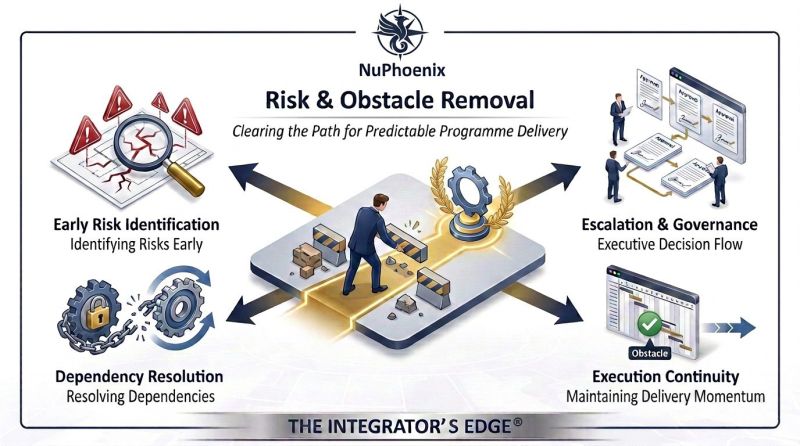
Integrators maintain forward motion by removing what delivery teams cannot. Projects do not fail because risks exist. They fail because risks are ignored until they become crises. That is why Integrators do not wait for problems to resolve themselves. They identify obstacles early, challenge assumptions, and remove barriers before they disrupt execution.
Risk & Obstacle Removal is about protecting momentum across the programme. Many of the most significant impediments lie outside the immediate control of delivery teams: governance delays, stakeholder misalignment, contractual decisions, resource constraints, and organisational dependencies.
An integrator has the judgement to recognise these issues early, the confidence to escalate them when necessary, and the determination to ensure they are resolved before they jeopardise delivery. This is another dimension of The Integrator’s Edge®: the capability to clear the path for successful execution by addressing risks proactively rather than reacting to failures after they occur.
Because successful programmes are not defined by how well they recover from avoidable problems. They are defined by how effectively those problems are prevented from happening in the first place.
Integrator Value #8: Value Delivery & Outcome Monitoring
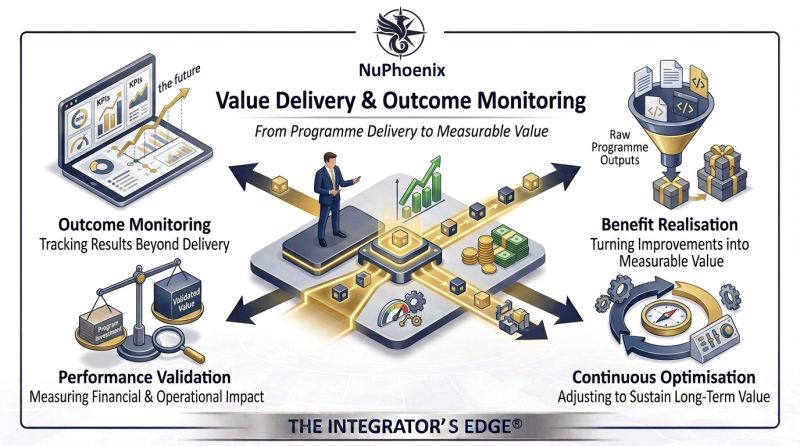
Integrators do not stop at delivery. They ensure delivery creates value. A programme can meet its scope, stay within budget, and deliver on time. And yet it can still fail to achieve the outcomes it was designed to create.
That is why Integrators look beyond completion. They monitor whether implemented optimisation measures are actually delivering the intended financial and operational benefits.
Value Delivery & Outcome Monitoring connects execution to measurable impact and this means that there is efficient and truthful tracking of outcomes beyond implementation, assessing whether expected benefits are being realised, and identifying where further intervention or adjustment is required.
An integrator maintains visibility beyond the point of delivery because improvements are not simply implemented and considered complete, but their actual impact is monitored to ensure they continue to support the objectives behind the programme.
This is another dimension of The Integrator’s Edge®: shifting the focus from completing scope to realising sustainable value.
Because successful programmes are not defined simply by what they deliver. They are defined by the value that delivery creates.
Integrator Value #9: Cross‑Functional Fluency
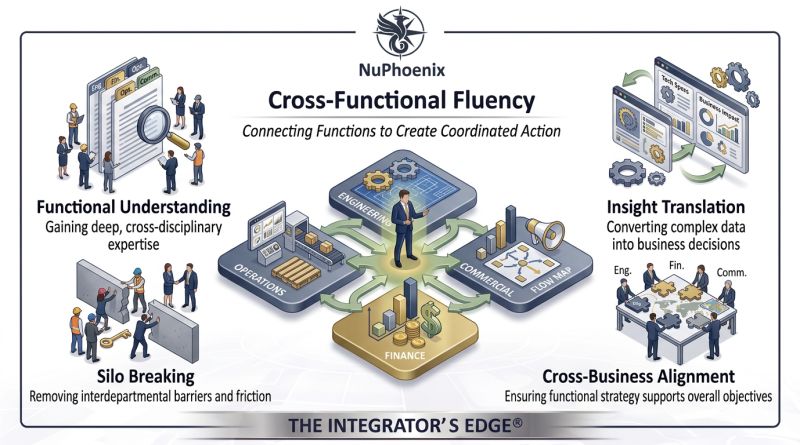
Integrators create alignment by connecting functions that do not naturally speak the same language.
Mega‑complex programmes span Engineering, Finance, Operations, Commercial and other domains. We understand that each discipline has its own incentives, vocabulary, and definition of success.
Cross‑Functional Fluency is the ability to understand enough of each discipline to connect the wider picture. Whether their background is engineering or finance, integrators must engage confidently across both, extract meaningful insight, translate priorities, and recognise how decisions in one area reshape another.
An integrator challenges functional silos, brings perspectives together, and acts as a change agent across organisational boundaries.
This is another dimension of The Integrator’s Edge®: turning diverse expertise into coordinated action around a shared objective.
Because successful programmes depend not only on functions knowing their own priorities but also depend on understanding how they contribute to the whole.
Integrator Value #10: Stakeholder Diplomacy
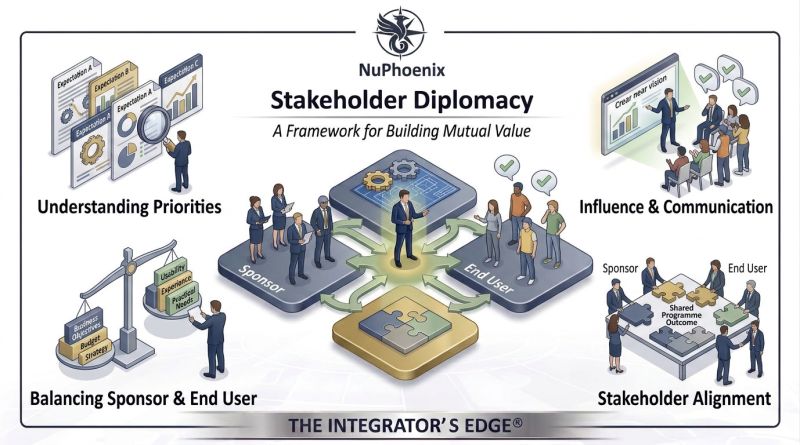
Integrators create alignment by balancing the needs of those funding the work with those who will ultimately experience its outcomes.
Mega‑complex programmes bring together Sponsors, End Users, wider stakeholder groups and each with different priorities, expectations, and measures of success. What creates value for one group may not fully align with what another requires.
Stakeholder Diplomacy is the ability to navigate these competing perspectives without losing sight of the shared objective. Integrators must understand what matters to each stakeholder, communicate a clear vision across diverse audiences, influence decisions, and recognise where expectations need to be challenged or reconciled.
An integrator builds trust between groups, translates priorities, and keeps conversations focused on the value the programme is intended to deliver.
This is another dimension of The Integrator’s Edge®: turning competing stakeholder needs into coordinated action around a shared outcome.
Because successful programmes depend not only on satisfying individual stakeholders. There are serious dependencies on creating alignment between those shaping the outcome and those who will ultimately experience it.

Contact Details
For a confidential, multi-discipline project health check,
please contact us:
Email: info@nuphoenix.co.uk
Registered and correspondence address:
NuPhoenix Limited, 47 Butt Road, Colchester CO3 3BZ England, UK
Telephone number: +44 1206 564 379